The art behind the evening
Cretan music and dance: what you will hear
The lyra, the laouto, the pentozali, the syrtos and the sung couplets called mantinades, explained for first-time listeners at a Cretan night.
Book the Cretan night ↗Quick answer
Cretan village music is led by the lyra, a pear-shaped three-string fiddle played upright on the lap, with the laouto, a long-necked lute, keeping the rhythm beneath it. The dances are line and circle dances: the leaping pentozali, the linking syrtos and the widely loved kalamatianos. Between dances, singers trade improvised rhyming couplets called mantinades. Expect to be invited into a line, and to be shown the steps first.
What you will hear and see
| What it is | Role | |
|---|---|---|
| Lyra | Three-string bowed | Leads the tune |
| Laouto | Long-necked lute | Keeps the rhythm |
| Pentozali | Leaping dance | The island's signature |
| Syrtos | Linked line dance | Easy to join |
| Mantinada | Sung couplet | Improvised answers |
The lyra, the voice of Crete
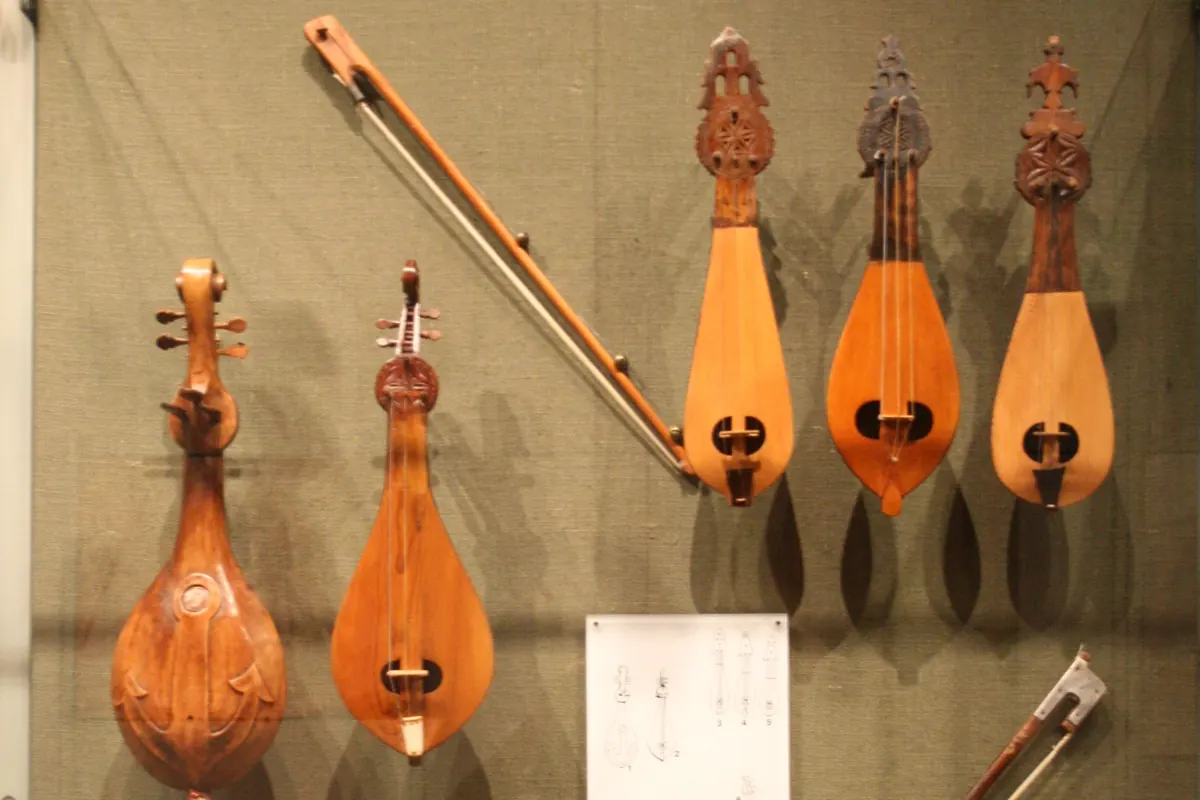
The Cretan lyra is a pear-shaped bowed instrument with three strings. The player holds it upright on the lap, like a small viol, and stops the strings with the fingernails of the left hand rather than pressing them to a fingerboard. That gives it a different tone from a violin. The lyra is the instrument most associated with Cretan village music and is considered the most popular surviving form of the medieval Byzantine lyra, an ancestor of most European bowed instruments. At a Cretan night it is the instrument that carries the tune while the dancers move. Lyras come in more than one size: a small one for dance music and a larger, stronger-voiced one for accompanying songs.
The laouto underneath
The laouto is a long-necked, fretted lute with four double strings, played with a long plectrum. It looks like an oud, but its steel strings and longer neck make it brighter, and its frets can be moved to suit the modes of Greek traditional music. On Crete the larger Cretan laouto is the usual one. Its job is accompaniment: in the pentozali, the main tune is played on the lyra or violin while the laouto plays in a more percussive, rhythmic way. Lyra, violin and laouto are the instruments that predominate in Cretan music, so expect that sound all evening. The mandolin, oud and guitar are also common in Cretan music, which is why a stage group can look larger than a lyra and a laouto alone.
Where the sound comes from
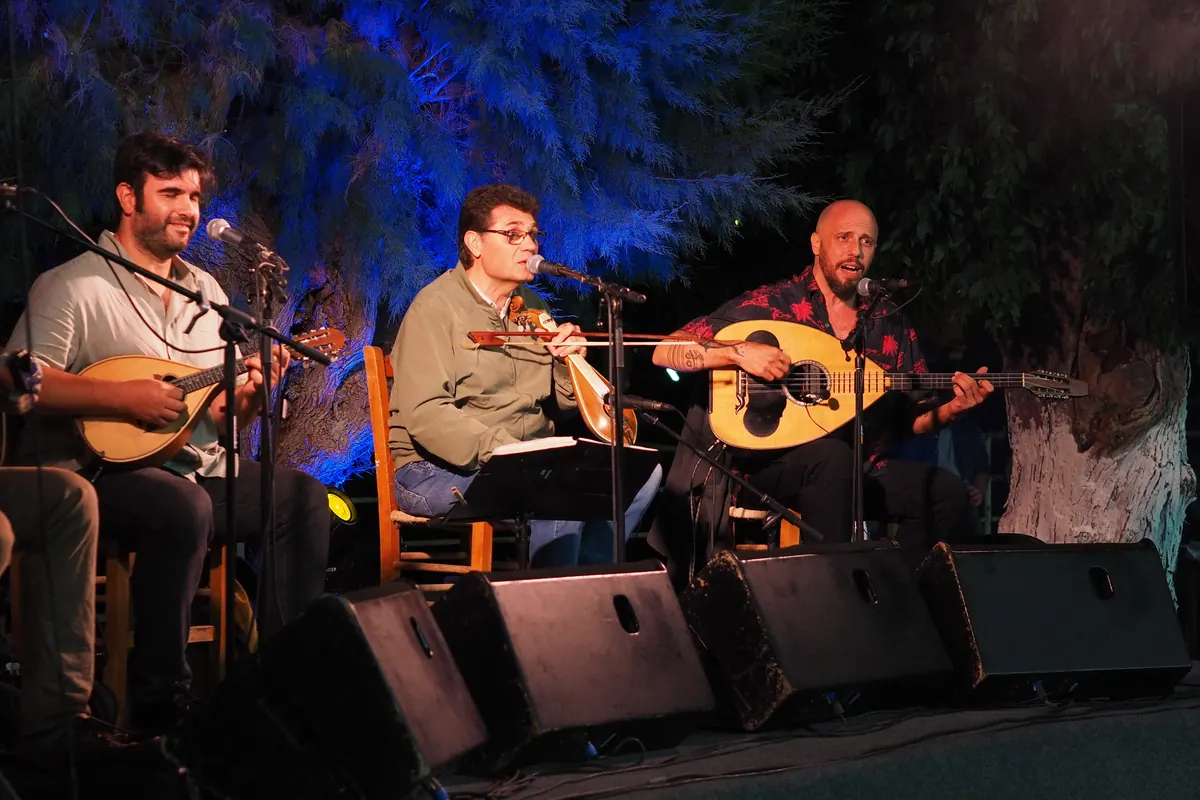
The first recorded reference to a lyra dates from the 9th century, when a Persian geographer listed it as a typical Byzantine instrument. Later centuries of Venetian rule brought the violin and its influence on Cretan tunings and repertoire, and by the early 20th century the modern lyra had formed from a small older lyra and the violin. Cretan music is closely tied to dance: its common forms match dances such as the syrtos, pentozali, siganos, pidikhtos and sousta. That is why a single tune on a lyra at a village night can make a whole room stand up. The tradition is layered: the Byzantine lyra came first, and centuries of Venetian rule left the violin's mark on it.
Pentozali, the leaping dance
The pentozali is the trademark folk dance of Crete. Its name means five steps, though the dance has ten in all, and it is a vigorous, high-jumping dance that begins at a moderate or fast pace and speeds up. Dancers hold one another by the shoulders in an incomplete circle. The first dancer improvises, while the second stands rigid to give a stable base, and then the first dancer moves to the back of the line. Men and women both dance it, though the women's steps were traditionally more restrained, because a long dress does not allow high jumps. It is described as a war dance, and the way the first dancer yields their place down the line is thought to echo the chain of command in battle.
Syrtos and kalamatianos, the dances you can join
The syrtos is a line or circle dance in which the dancers link hands behind a leader, who now and then breaks away to improvise. On Crete it is in 4/4 time and is typically played to an up-tempo lyra melody. Its relative, the kalamatianos, uses the same steps in 7/8 time, in a slow, quick, quick rhythm, and is among the most popular dances throughout Greece and Cyprus, seen at weddings and religious festivals. Because the dancers hold hands in a line, a newcomer can take a place at the end and follow the feet in front. In some syrtos, the second dancer steadies the leader with a twisted handkerchief during the improvised turns.
Read next: What to wear and bring to a Cretan night
Sirtaki, the film dance
Many visitors already know one Greek dance, the sirtaki, and it is no village tradition. It was devised for the 1964 film Zorba the Greek, to a score by Mikis Theodorakis, and blends the syrtos, whose name comes from a drag style, with the slow and fast rhythms of the hasapiko, an amalgam of three dance styles in all. Its name suggests a traditional Cretan root, but the dance was created for the film rather than handed down. If a sirtaki appears on your night, enjoy it as the dance the world learned from the cinema, and watch for the pentozali and the syrtos as the island's own.
The taximi and the shape of a tune
Before a dance-song begins, a Cretan player may open with a taximi, a rhythmically free, improvised instrumental solo that comes before the song. Then the rhythm arrives and the dancers move. Tradition holds that two melodies from Chania, the Protos and the Deuteros Chaniotikos, are the archetypes of all other Cretan syrtoi, so even new tunes often echo old ones. Older lyras keep one string as a drone, so listen for a steady note under the melody.
Mantinades, poetry sung back and forth
A mantinada is a rhyming couplet of fifteen syllables, often improvised on the spot during dance music, and usually about love or gentle mockery. Each line splits into two halves, of eight and seven syllables. On Crete mantinades are performed to the lyra and the laouto. They are often antiphonal: one verse draws an answer, which draws another, so singers can trade lines like a conversation. Couplets from the Cretan Renaissance verse epic Erotokritos have also been used as mantinades. You may not catch the words, but you will hear when a line lands, because the room reacts before the music moves on. The form became popular at the end of the 14th century.
Costume and why the vraka matters
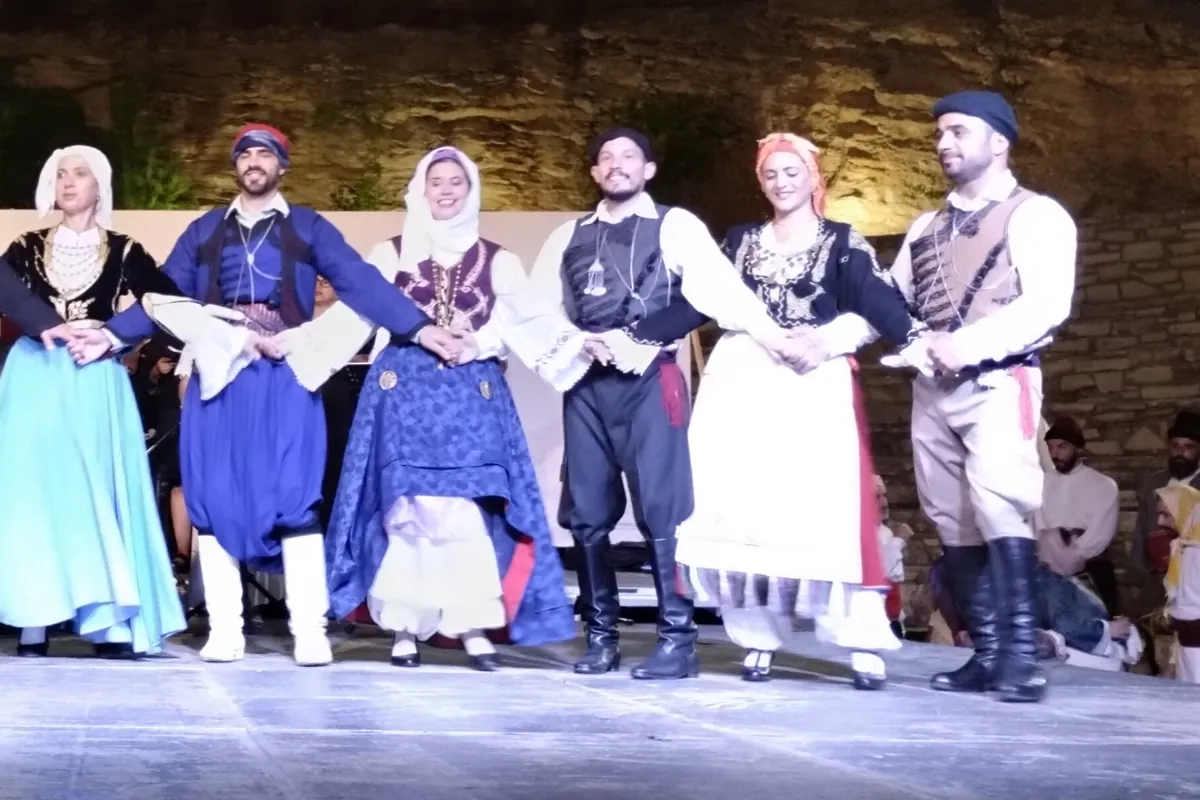
Cretan menswear includes the black vraka, breeches worn tight at the waist and thighs and loose and baggy around the hips. That cut makes acrobatic dancing possible, which is why it suits the pentozali's jumps. Women's dress was traditionally a long dress, which shaped their steps toward the more restrained. At a village night the costumes are part of the show, and they are a quick way to read the dance: the bold jumps belong to the vraka, the careful steps to the long dress.
Being a first-time listener
You do not need to know the dances to enjoy the night. Watch the leader of the line, who improvises and sets the tone in both the pentozali and the syrtos. Take the hand of the person next to you, follow the feet in front of you and let the steps repeat until they feel natural. If you would rather listen than dance, watch the lyra player: the soloist often directs the flow of the dance, improvising to signal the lead dancer, then returning to the main tune. Either way, the music is the part worth paying attention to, and the more you listen, the more the dances make sense. Bring ears first and feet second.
Who this isn't for
A Cretan night is a show for visitors, so it presents the tradition in a polished, crowd-friendly form. If you want the music on its own terms, in a quiet hall, this is not that evening. Heraklion's municipality notes that its summer events include traditional Cretan music alongside modern music, dance and theatre, so look there for a different setting. If you dislike amplified sound, a large room or being invited to dance, choose a quieter way to meet the lyra. A museum of folk instruments, such as the one in Athens that holds Cretan lyras, is another gentler route into the instrument.
Frequently asked questions
What is the Cretan lyra?
It is a three-stringed, pear-shaped bowed instrument held upright on the knee. It is central to the traditional music of Crete and descends from the medieval Byzantine lyra. Players stop the strings with the fingernails of the left hand, which gives it a tone different from a violin.
What plays alongside the lyra?
Usually a laouto, a long-necked lute that provides rhythm and harmony. Violins, mandolins and guitars also join Cretan groups, but lyra, violin and laouto predominate. Together they carry the dance tunes at a village night.
Is sirtaki a real Cretan dance?
No. It was devised for the 1964 film Zorba the Greek and mixes syrtos with hasapiko rhythms. The pentozali and the syrtos are the traditional Cretan dances, and the kalamatianos is a widely loved cousin of the syrtos.
What is a mantinada?
A fifteen-syllable rhyming couplet, often improvised and usually about love or satire. Singers often answer one another, verse by verse, to the lyra and laouto.
Must I know the steps beforehand?
No. Guests are invited to learn simple steps, and the line dances let a newcomer take a place at the end and follow the feet in front. Watching is also fine.
Sources